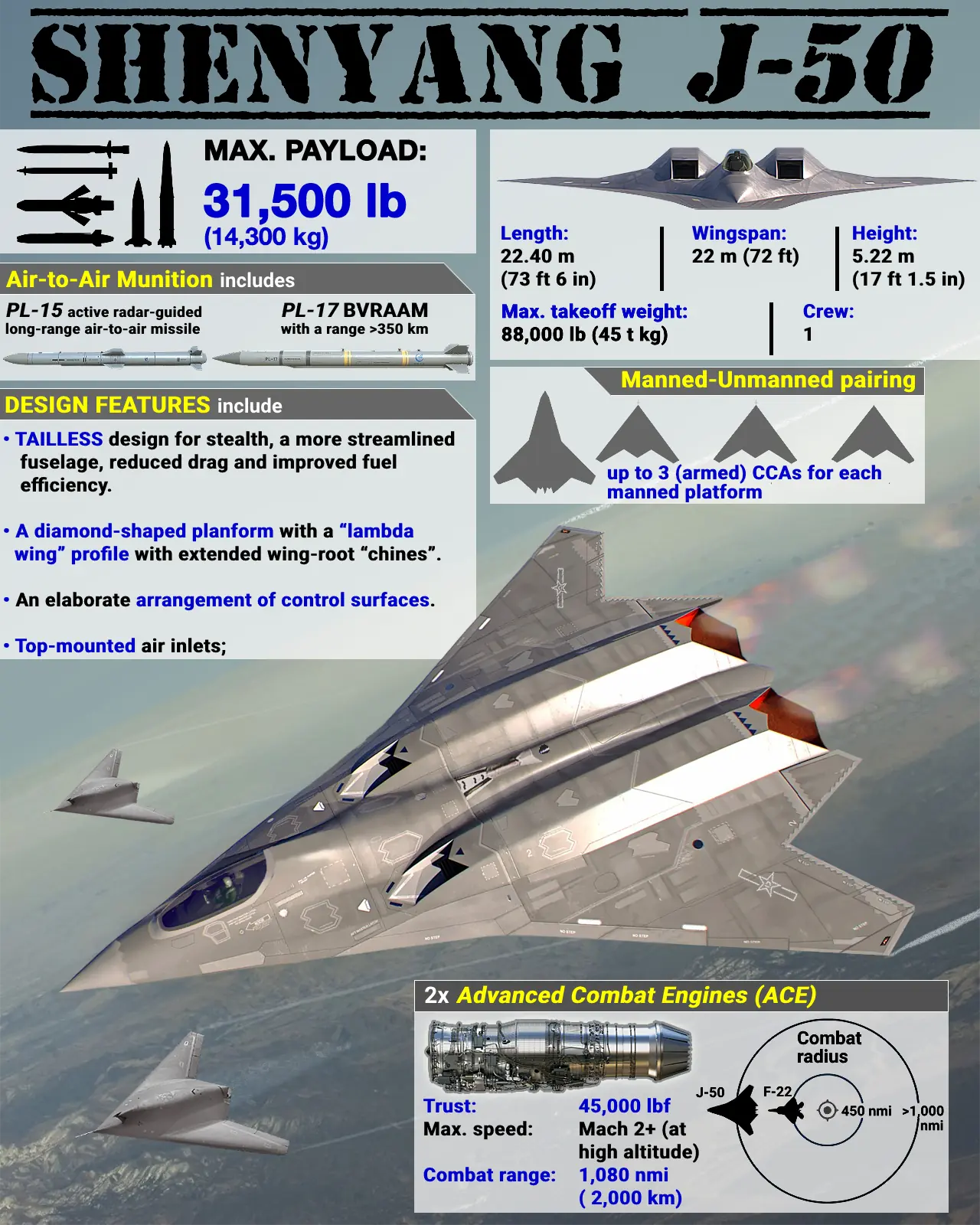
The Shenyang J-50, J-XD, or J-XDS, is a temporary designation given by military analysts and defense media to a twinjet tailless lambda wing aircraft under development by the Shenyang Aircraft Corporation (SAC). The aircraft was observed in flight testing in Shenyang, Liaoning, China in December 2024, which was tentatively named Shenyang J-XD or Shenyang J-50 by analysts, given the limited available information.
History
In 2018, Shenyang Aircraft Corporation (SAC) reportedly developed prototypes for the next-generation aircraft. Intelligence and rumors indicated the Chinese designs would use tailless flying wing or flying arrowhead configuration that can provide greater broadband stealth characteristics compared to the previous generation of fighters, new propulsion technologies, improved sensors allowing the aircraft to operate alongside unmanned teaming aircraft or unmanned combat aerial vehicles (UCAVs), etc.
In September 2022, United States Air Force (USAF) General Mark D. Kelly, head of the Air Combat Command (ACC) suggested China was on track with its six-generation fighter program, and he believed the Chinese design uses a 'system of systems' approach like the United States, which allows for "exponential" reductions in stealth signature and improvements in processing power and sensing.
On 26 December 2024, a new Shenyang prototype aircraft, believed to be part of the Chinese sixth-generation fighter program, was spotted near Shenyang Aircraft Corporation's facilities. The reveal coincided with the spotting of the Chengdu J-36 from its sister company, Chengdu Aircraft Corporation. Unconfirmed reports suggested the Shenyang fighter made its maiden flight on 20 December 2024. The Shenyang aircraft prototype seemed to be smaller than the Chengdu one. It was trailed by a Shenyang J-16 strike fighter as the chase plane.
Subsequent new images, which appeared in January and April 2025, allowed observations to confirmed several details, including the aircraft's lambda wing configuration, swivelable wingtips as control surfaces, twin-engine with apparent thrust vectoring nozzles, while debunked a hypothesis suggesting the aircraft has folding empennage.
Design
The Shenyang prototype fighter features a cranked arrow configuration with sharply swept lambda wings and articulating, swivelable wing tips acting as control surfaces. The lambda wing design has a triangular trailing-edge extension that connects to the end of the engine bay, increasing aspect ratio and improving the aerodynamic efficiency compared to traditional trapezoidal wing. Each wing also features a differential leading-edge extension (LRX) and multiple trailing edge control surfaces. The aircraft has a long nose radome with an electro-optical targeting system (EOTS) housing mounted underneath, which is followed by two v-shaped ventral intakes with diverterless supersonic inlet (DSI). At the tail are twin-engine bays with thrust vectoring nozzles. The aircraft has a twin-wheeled nose landing gear and two single-wheeled aft landing gears in a tricycle configuration. Two ventral weapons bays are visible, with a centerline tunnel indented in between the two bays. Side weapon bays are also visible. The medium size of the aircraft was speculated to be more suitable for operations on aircraft carriers. The cockpit canopy was not visible from any available footage of the aircraft, leading to diverging theories on it being a crewed, uncrewed, or optionally crewed aircraft.
See also
- Sixth-generation fighter
Aircraft of comparable role, configuration, and era
- Chengdu J-36
- Boeing F-47
- Mikoyan PAK DP
- Global Combat Air Programme
- Future Combat Air System
Related lists
- List of fighter aircraft
- List of aircraft produced by China
- List of active People's Liberation Army aircraft
References